(CNN)The
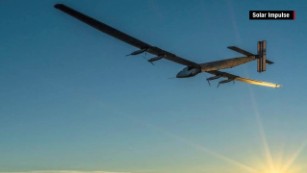
Solar Impulse 2, the experimental plane attempting to fly around the
world without a single drop of fuel, might not be able to complete its
journey this year, according to one of its pilots.
Andre
Borschberg, a Swiss engineer and former fighter pilot, and co-founder,
psychiatrist and explorer Bertrand Piccard, have long said there was
always a chance their mission would fail, though that would not deter
them from trying.
But over the last
couple of weeks, while the Solar Impulse has been grounded in Japan
awaiting a clear weather window for its next leg to Hawaii, there has
been a gradual shift in tone about the prospects for the journey ahead.
"There are chances that we can make it," Borschberg told CNN from Nagoya.
"But there are risks also that we can't make it on time," he said.
Solar plane hopes to circumnavigate the globe
Daylight essential
It all comes down to science.
The
Solar Impulse team says they scheduled the journey, which began in Abu
Dhabi in March and was meant to end by July, to maximize the amount of
daylight.
The top of the plane's wings
and fuselage are covered with more than 17,000 solar cells. And
gathering the sun's rays during the day allows the Solar Impulse to fly
continuously through the night on battery power, typically at a speed no
faster than a car.
But there will be a
cut-off point, Borschberg said, when there is no longer enough sunlight
in the Northern Hemisphere to make that possible.
"We ate our margin," Borschberg said, referencing almost two months of weather-related delays in China.
When
the Solar Impulse finally took off from Nanjing for Hawaii, a dangerous
weather front over the Pacific Ocean forced Borschberg to divert to
Nagoya, Japan on June 1, landing after 44 hours in flight.
While
on the ground, strong winds and rain damaged one of the plane's
ailerons, a critical part of the wing that is used to maneuver the
aircraft.
The wing has since been repaired and the plane cleared by the engineering team for take off for Oahu.

The
silver lining, Borschberg says, is that the performance of the airplane
has been slightly better than expected, which means that he and
Piccard, who take turns flying the plane solo, might have until late
August or possibly early September to reach the finish line.
And
Borschberg says his two-day nonstop flight from China gave him a
confidence boost in the capabilities of both man and machine.
That
flight, the team says, was a success, because it proved that continuous
flight was possible and also set a new record for the longest manned
journey by solar plane.
Borschberg says he gradually built enough trust to be able to take 20-minute naps while the Solar Impulse flew on autopilot.
No daredevils
But the sun continues to decide the schedule.

While
the team at the Mission Control Center in Monaco continues to evaluate
every opportunity, it is difficult, Borschberg says, to forecast weather
for a trip that might last as long as five or six days.
If
there is a portion of the flight that will be risky because of
high-level clouds or the possibility of ice, he says, they want to
tackle that as early as possible.
So far, nature isn't cooperating. And patience has slowly begun to give way to frustration.
On Friday, the Solar Impulse team released a video featuring Bertrand Piccard and a handful of the 150 members of the team, titled: "Why are we still in Nagoya?"

"We
don't want to be daredevils," Piccard said bluntly. "It would be
stupid," he says, to fly blindly into the unknown, given the technology
at their fingertips.
The last thing
they want, both Piccard and Borschberg have previously said, is to be
forced to bail out of the plane over the open ocean, though both pilots
have trained for that possibility, and rescue plans worked out for the
worst-case scenario.
After Borschberg
lands in Hawaii, Piccard is scheduled to fly the next leg to Phoenix,
Arizona. Eventually, the plane will attempt to cross the Atlantic Ocean
and return to Abu Dhabi, completing its 35,000 kilometer journey, which
is meant to showcase the power of clean technology.
And
even with all the delays and uncertainty, the pilots have made one
thing clear: they are willing to wait as long as it takes to complete
an adventure now more than 12 years in the making.
"If we cannot finish this year, we will finish next year," Borschberg said. "That's for sure."

No comments:
Post a Comment